Private audio workflow
VoxNotch
A private studio for recordings that cannot leave your machine. Get high-quality local transcription, design voices, produce podcasts and captions, and let agents automate bounded work around your own instance.
Runs on Docker. Local speech recognition by default. No telemetry.
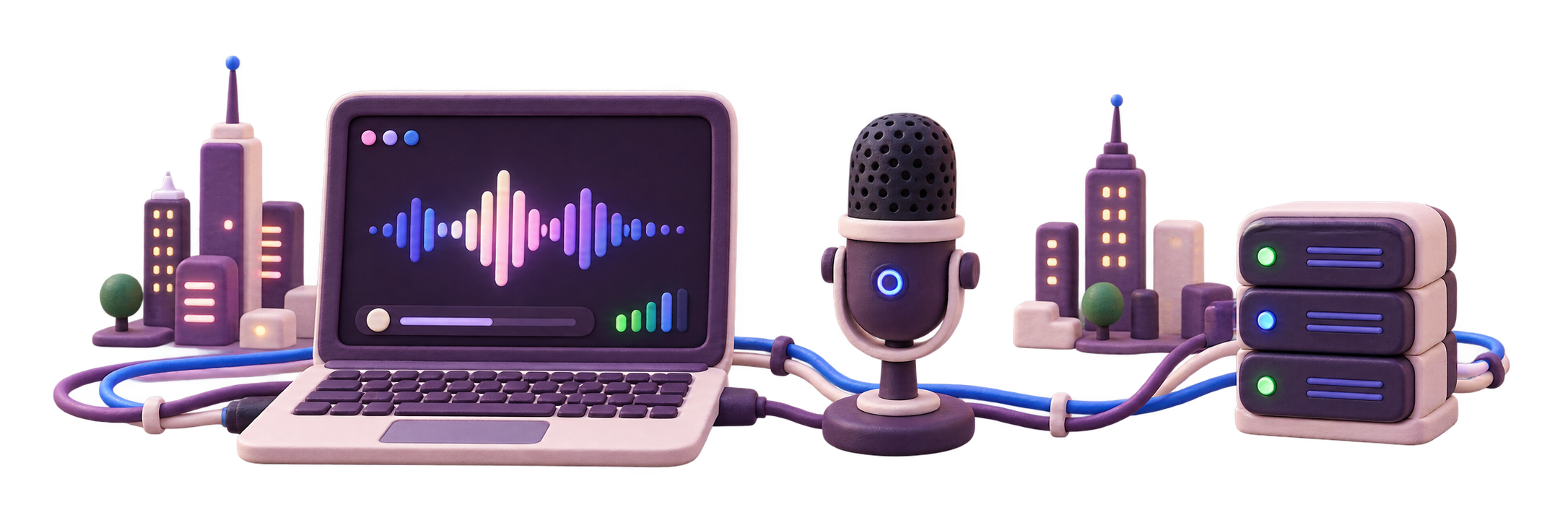
Claymation studio scene: microphone, local server, recorder, and file tray.
Choose the evaluation path that matches your concern.
Workflow map
One spine, many jobs.
Every persona uses the same product path. What changes is the output: records, clips, captions, narration, reports, or automated handoffs.
- 01CaptureRecord, upload, watch a folder, or call the API.Follow step
- 02TranscribeRun high-quality local speech recognition with timing.Follow step
- 03ReviewEdit speaker-aware transcripts, notes, tags, and collections.Follow step
- 04ProduceExport captions, podcasts, narration, clips, and reports.Follow step
- 05AutomateUse recipes, webhooks, agents, and operator checks.Follow step
The problem
Every tool that understands your audio wants a copy of it first.
Transcription services upload it. Editors upload it. Voice tools upload it, and keep the voice model afterwards. For a lot of recordings — a client session, an unpublished interview, a source who asked you not to — that is not a trade-off. It is a hard no.
So the work gets done badly, or not at all, or done anyway while you try not to think about the terms of service.
What it replaces
One install instead of four subscriptions.
| What you rent | What VoxNotch does |
|---|---|
| Transcription (Otter, Rev) | Whisper on your hardware, any length, no per-minute fee |
| Editor (Descript) | Transcript-driven edits, chapters, mastering |
| Voice (ElevenLabs) | Local synthesis and cloning; the model stays on your disk |
| Studio (Riverside, Podcastle) | Podcast assembly, audiograms, delivery packages |
How it works
Capture. Understand. Produce.
Capture
Record in the browser, drop in a file, or point a watch folder at a directory and let it ingest on its own.

Browser capture, with a watch folder ingesting a second file in the queue. Understand
Transcripts with speaker separation, searchable across your whole library. Notes anchored to the exact moment in the audio. Summaries and reports when you want them, and never automatically.

A transcript with speaker separation and a note anchored to the playhead. Produce
Turn any of it into something finished: a podcast episode with chapters and proper loudness, a captioned vertical clip, a narrated audiobook, a dubbed version in another language.

The podcast studio with a chapter list and the loudness meter on the master bus.
Privacy architecture
Not a promise. An architecture.
Most private-AI claims mean "we promise not to look." This one means the network path is not there.
Local by default
Speech recognition runs on your box. No upload, no per-minute billing, no third party in the audio path. Sign-in is the one exception and it never sees your media — see the privacy page.
faster-whisper, running in your own container.
Cloud is opt-in, and optional means optional
Every path that could use a cloud model or an LLM has a working no-cloud floor. Turn it off and the feature degrades — it does not break, and it does not quietly fall back.
The app cannot fetch a model
It cannot name a repository, accept a runner URL from a request, or download weights. Heavy engines run in isolated runners you deploy on purpose, reachable only over loopback.
Your data does not expire
Nothing is aged out, archived, or deleted except by you.
Honest limits
What this is not.
It is not easier than a SaaS subscription. It is a Docker stack with a database, a job queue, and workers. You will need a machine to run it on and an hour to set it up.
It is not a team product. It is built for one owner per instance.
It is not magic. Transcription quality is Whisper’s quality. Synthesis quality is the model’s quality. What is different is where they run.
Start with one recording when the beta opens.
git clone <repo> && cd web && ./scripts/launch/first-run.sh